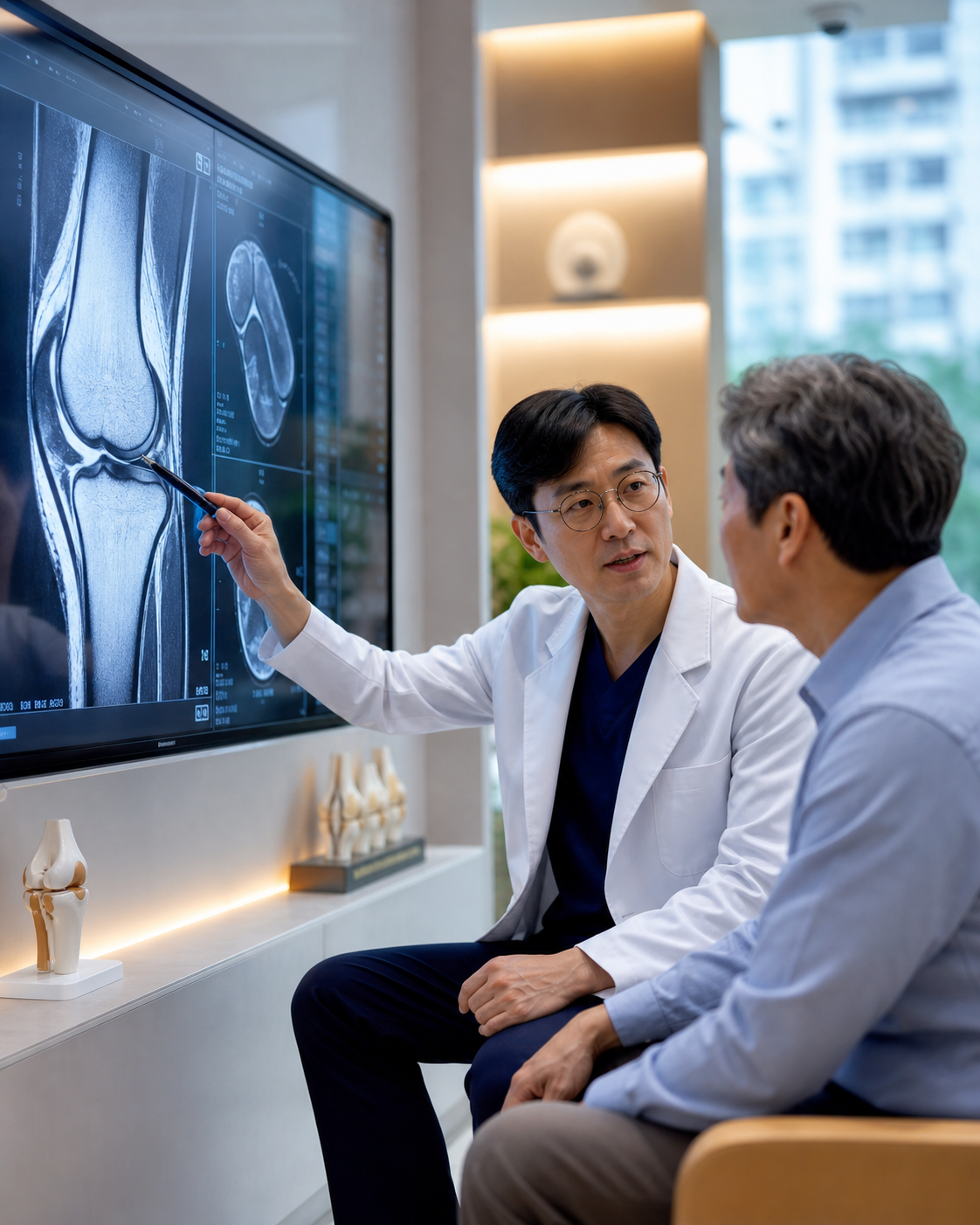
South Korea and Japan are delivering outcomes in stem cell surgery for knee osteoarthritis that aren't available anywhere in the United States. MyMediTour coordinates private, concierge-level access to the world's leading specialists.
Knee osteoarthritis affects over 32 million Americans. The standard US treatment path — cortisone injections, then total knee replacement — often leaves patients with years of pain management, followed by a 12-month recovery and an artificial joint that wears out in 15–20 years.
Stem cell surgery targets the root of the problem: cartilage degeneration. It doesn't replace your knee — it repairs it.
South Korea has a decade of documented outcomes and MFDS-approved treatments that aren't available in the US. Japan's new regulatory framework opens access to revolutionary protocols — including MyMediTour's newest partnership.
Over a decade of approved stem cell outcomes
South Korea's MFDS-approved allogeneic stem cell treatment for knee cartilage repair. The only government-approved allogeneic stem cell product for osteoarthritis in the world. MyMediTour has directly coordinated patient cases here with strong outcomes.
South Korean orthopedic surgeons have refined stem cell arthroscopy into a precise, same-day procedure. Patients typically fly in, undergo treatment, recover locally for 1–2 weeks, and return home — often without crutches.
Next-generation protocols — now open to US patients
Japan's Act on the Safety of Regenerative Medicine has created one of the most advanced environments for approved cell therapies. MyMediTour has just completed a direct partnership with leading Japanese orthopedic centers, opening intake for US patients for the first time.
This is not an injection. It is a precision arthroscopic procedure that delivers concentrated stem cells directly to damaged cartilage — allowing biological repair where the joint has degenerated.
MRI review, X-rays, and patient history are submitted to the surgical team. Eligibility and protocol are confirmed before travel is arranged.
In allogeneic protocols (Cartistem), donor-derived stem cells are prepared. In autologous protocols, cells may be drawn from the patient's own bone marrow or fat tissue.
A minimally invasive arthroscopic approach delivers stem cells precisely to the cartilage defect under direct visualization. Procedure duration is typically 1–2 hours.
Patients typically rest locally for 1–2 weeks, with physiotherapy beginning within days. Most patients fly home without assistance.
Stem cells integrate into cartilage over time. Most patients report significant pain reduction and functional improvement within 3–4 months.
Stem cell surgery is not suitable for every patient or every stage of osteoarthritis. The following profile represents good candidacy — final eligibility is always determined by the surgical team after medical review.
Grade IV (bone-on-bone) OA may still qualify depending on the case and protocol. Submit your case for evaluation — our team will advise honestly on suitability before you make any decision.
Request My EvaluationMyMediTour's coordination model is built for patients who expect a high standard of service. Your coordinator is a single point of contact across every stage.
Submit your case details, imaging, and questions. No commitment, no pressure.
A dedicated coordinator reviews your case and recommends the right destination and clinic within 24 hours.
The matched clinic reviews your imaging and confirms protocol, eligibility, and a detailed cost estimate.
Scheduling, logistics, accommodation guidance, and pre-travel preparation — all coordinated through MyMediTour.
Your coordinator stays reachable through treatment and recovery. Post-return check-ins are standard.
Submit your case details and a MyMediTour coordinator will personally review your situation and provide an honest assessment — including whether this treatment is appropriate for your specific condition, which destination fits best, and what realistic outcomes look like.
Tell us about your case. The more detail you provide, the more useful our initial assessment will be.